What your fridge says about…
Relationships
You're not dating a person. You're dating their systems, and the fridge is the first one you see.
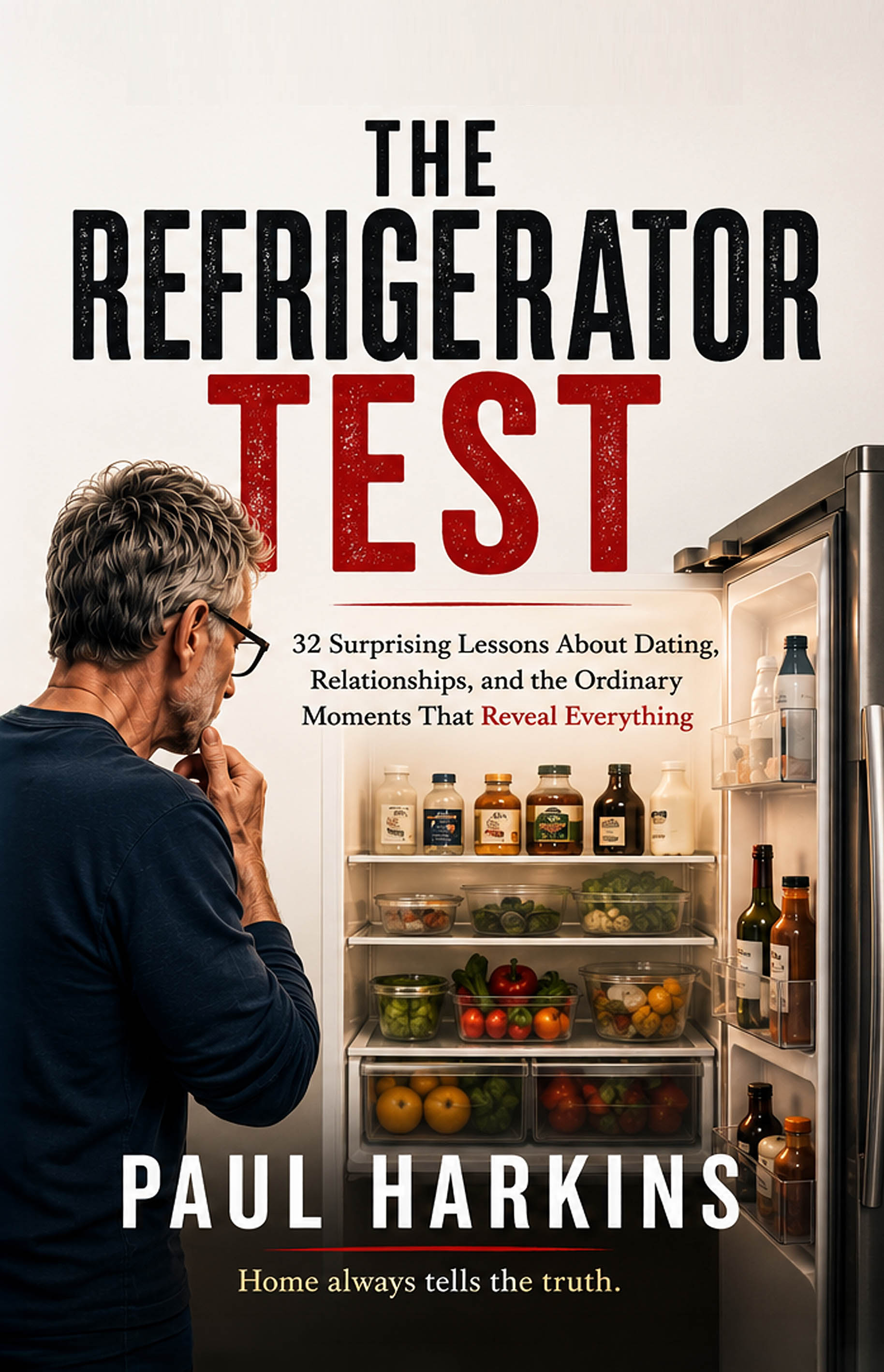
The whole book, in a way, is about this one. The Refrigerator Test exists because Paul Harkins started dating again in his fifties and noticed something nobody warns you about: candlelit dinners are useless as diagnostics. The candlelight is a filter. The wine is a filter. Being on your best behavior is the biggest filter of all. If you want to know who someone actually is, you have to see the room they don't clean before you come over.
Usually that room is the fridge.
People are systems, not stories
On a first date, people tell you their story. The edited version. The parts that sound good out loud. Then, sometimes weeks later, you end up in their kitchen at eleven at night and they open a small, cold door, and there is the unedited version, humming quietly on a shelf.
You're not dating what they told you at dinner. You're dating what's in that fridge on a random Tuesday. You're dating the systems: how they feed themselves, whether they plan, whether they clean up, whether there's room for another person or every square inch is already claimed by their own life.
Systems are what you actually live with. Stories are what you fall for. The gap between the two is where most relationships quietly break.
What compatibility actually looks like
Two Planners can be blissful together. Two Intenders will eventually starve or divorce, but they'll enjoy the takeout. A Curator and a Host is a war of aesthetics versus abundance, beautiful for a while, exhausting later. A Minimalist with a Survivor is a Netflix pilot: charming in the first episode, unwatchable by the third.
Compatibility isn't about matching. It's about tolerating the same amount of mess. If your fridge is a labeled grid and theirs is a graveyard, the honeymoon will hide it and the second year will not. It's not that one of you is right and one is wrong. It's that you handle daily life in different rhythms, and daily life is what a relationship is, once the fireworks quiet down.
The refrigerator as advance warning
Harkins is careful in the book not to be smug about this. He's not writing as a man who figured it out. He's writing as a man who repeatedly did not figure it out and paid the price in three-month relationships. The refrigerator became the shortcut he wished he'd had for the previous thirty years.
A fridge with nothing but takeout containers is not a moral failing. But it tells you the person hasn't been feeding themselves, and you should not become the person they start feeding themselves through. A fridge lined with kombucha and lifestyle beverages is telling you that image is doing a lot of load-bearing work in this person's life. Neither is a dealbreaker. Both are data.
The point isn't to reject people based on their crisper drawer. It's to update your expectations before your feelings do it for you.
The shared-fridge test comes later
The first fridge tells you about them. The second, harder test comes if the relationship goes anywhere: whose fridge do you end up living out of?
Every couple negotiates a fridge. Whose staples win. Whose weird condiments get shelf space. Whether leftovers stay for three days or four. Whether the top shelf is beverages or dinner. These sound like small fights. They're not. They're the operating agreement of your daily life.
Couples who can't negotiate a fridge cannot negotiate money, in-laws, or whose turn it is to book the trip. It's the same muscle. The people who casually move each other's yogurt to make room are the people who casually move each other's needs to make room, years later, without keeping score.
Peace is a dating preference
One of the lines in the book that sticks with people is: peace is a dating preference. You are allowed to want a partner whose life doesn't set off small alarms every time you look at it. You are allowed to notice, on the second date, that their fridge feels calm, that there is a stack of clean tupperware and a container of soup and a wedge of cheese that has clearly not been forgotten. That is not boring. That is not the absence of chemistry. That is chemistry with a low resting heart rate.
Chaos is exciting the first time. It's tiring the fiftieth. If you're old enough to be reading a book about it, you're old enough to admit that peace, when you finally taste it, does not feel like settling. It feels like exhale.
Reading your own fridge before you read anyone else's
The uncomfortable move Harkins makes late in the book is to turn the test around. It's easy to open someone else's fridge and diagnose them. It's harder to open your own and be honest about what you're offering the next person who walks into your kitchen.
If your fridge is a Curator fridge, beautiful, aspirational, uninhabitable, the person who moves in with you is going to be hungry. If your fridge is a Survivor fridge, you're going to resent the Planner who tries to save you. If your fridge is empty because you're always working, you're going to bring that same emptiness to the table on a Sunday morning when your partner just wants to hang out.
The best move, in dating and in every other part of adult life, is to fix your fridge before you shop for anyone else's. Not because a person has to be perfect. Because a person has to be legible. To themselves first, and then to someone else.
That's the whole test. Not "is their fridge pretty." Not "does it match yours." Just: can I see who they actually are, before I fall for who they said they were?
Open the door. Look inside. Believe what you see.